

Values – Small Tests
Happy Sunday!
Values – Small Tests
Did our oldest daughter’s skiing improve after her bindings got tightened?
You know it did!
She crushed a couple small mogul trails and even a big glade with ease. And a massive smile on her face.
‘Less wrong tomorrow’ is super satisfying when you realize the incremental progress being made.
Unfortunately, we’re not on the mountain this weekend since Alyssa enforces a strict “if it’s below zero, the kids can’t ski” policy. Can you believe that?
A responsible parent.
Let’s dive in!
This month is about VALUES, the underpinning of your family’s financial plan and the reason you’re working so hard. We’re covering:
Statement of Financial Purpose
Big Blue Arrow
Small Tests
Small tests are how you turn clarity into action without confusing decisiveness with recklessness.
Can ≠ Should.
High-earning Veterans with MBAs sit in a rare position.
You’re not just confident, you’re capable. That confidence is backed by experience. You’ve carried responsibility. You’ve made hard decisions under pressure. You have meaningful earning power, a demonstrated ability to save, and in many cases financial backing that gives you real optionality.
That combination makes big, bold decisions feel reasonable.
Sometimes they are.
The problem isn’t that you can’t do big things. It’s that the ability to do something doesn’t automatically mean you should do it all at once.
Rather than focusing on intelligence and discipline, think about what else is in play: switching costs. There is friction.
I assure you, there’s a gap between the clean, exciting version of an idea in your head and the reality of living with it day after day.
Real life adds things that don’t show up on spreadsheets:
Time constraints
Energy drain
Family dynamics
Maintenance, logistics, and coordination
Opportunity cost you only feel once you’re committed
“We’ll figure it out later” has a price. Undoing decisions takes money, time, and emotional bandwidth.
Simply being able to exit out doesn’t mean rushing in was wise in the first place.
Small tests are how you move forward without betting the farm on your crazy idea.
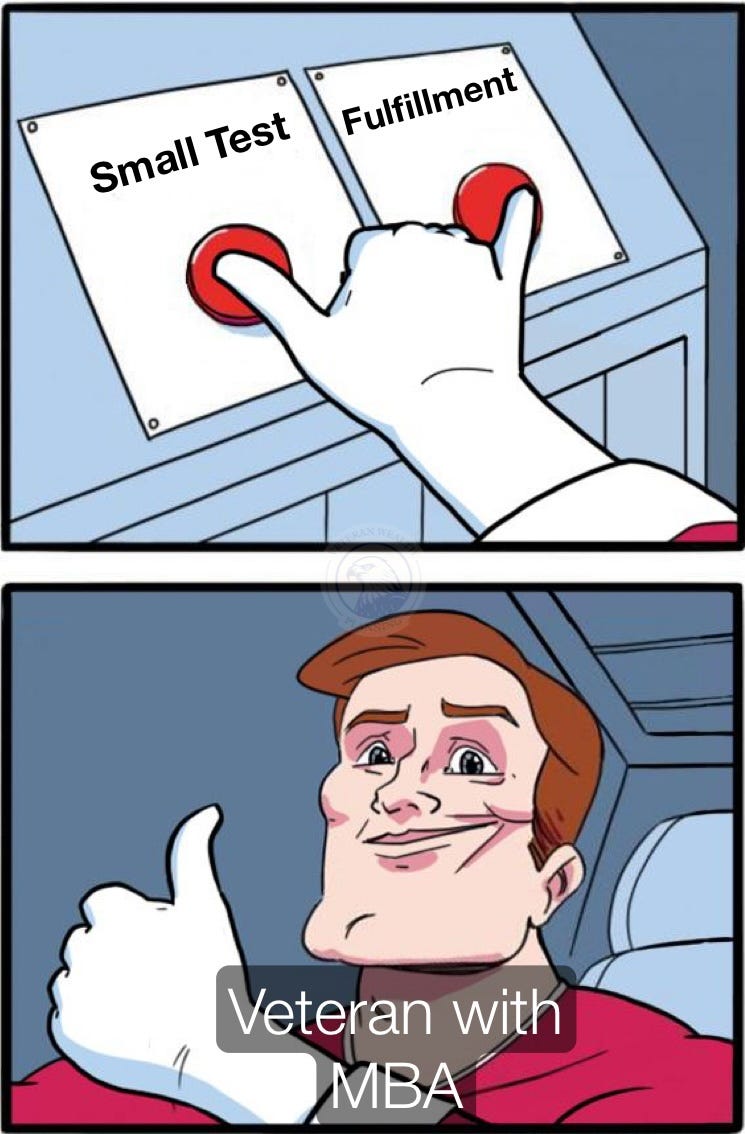
Toe In First.
Before committing meaningful capital, identity, or family energy, treat big ideas like hypotheses rather than conclusions.
Ask explicitly:
What don’t I know yet?
How could this be wrong?
A good small test probably has real skin in the game. But it preserves flexibility and creates learning rather than validation.
Time also matters.
It’s not just about whether something sounds good or works once. It’s about whether you still enjoy it after the novelty wears off.
Whether it fits into real weeks, not ideal weekends. Whether it supports your values six months in, not just on day one.
Here’s a personal example.
I want to own a boat.
Something like this one:

Why?
I love being on the water. I have great memories tied to it. It’s a place where I can find true relaxation and clarity. But I also enjoy quality and understand the responsibility that comes with owning nice things.
What I don’t have is lived experience owning a boat as an adult.
So rather than jumping straight to a dream scenario, I joined a local boat club. For about $5k a year plus fuel, I can test the hypothesis at a lower commitment level.
Here are some of the 25 boats we have access to:

You’ve probably noticed there’s a big gap between 21ft boats and 46ft ones. So have I.
But here’s what I’m trying to find out:
Do we actually use it as much as I think?
Can I work productively on the lake?
Do the kids enjoy it consistently?
Does my wife enjoy it?
Does it fit into real life or just the idea of life?
Do we get bored?
Do friends enjoy it?
Does our lake support the type of use I imagine?
This isn’t analysis paralysis. It’s deliberate learning. It’s respecting uncertainty I haven’t earned the right to dismiss yet.
Small tests can feel uncomfortable for people trained to be decisive. That discomfort doesn’t mean you’re being tentative. It means you’re being intentional and giving yourself room to make better follow-on decisions.
Medium Tests.
Small tests answer one core question:
Does this directionally support our Statement of Financial Purpose?
If the answer is yes, the next question becomes different:
At what level does this make sense for us?
Medium tests are where ownership friction shows up. Switching costs become larger. Responsibility increases. Preferences sharpen. Constraints reveal themselves. The “dream version” often changes.
What might this look like in the Preston family’s boat journey. Maybe something like this 32ft boat:

But I’m not committed yet, because we’re still testing with our toes in the water.
Going from no boat to a dream boat is a massive leap.
A medium step bridges the gap. Same category. Lower price point. Real ownership experience. Enough commitment to feel the tradeoffs without locking yourself in.
This is where you learn:
Do we like this brand?
This layout?
The maintenance?
The storage?
The actual cost, not the theoretical one?
Learning at a lower price point is a redeeming feature, not a failure. Refinement is the goal.
This ties directly back to last week’s idea of being less wrong tomorrow. You’re not avoiding action. You’re acting, observing, and narrowing uncertainty. Directional confidence improves. Momentum builds.
Again, this isn’t analysis paralysis. This is disciplined, responsible execution.
Commit and Reevaluate.
Remember, small and medium tests aren’t an excuse to avoid commitment. They exist to earn it.
And this isn’t endless testing. It isn’t fear dressed up as prudence. It’s acting, refining, and letting time reveal what spreadsheets and your imagination can’t.
At some point, the hypothesis has repeatedly survived contact with reality. Tradeoffs are understood. Over time, this path has proven supportive of your Statement of Financial Purpose.
That’s when big moves make sense.
Buying the boat. Starting the company. Moving locations. Doing the thing others won’t understand.
Those decisions aren’t reckless when they’re earned.
One framing matters here: this isn’t just your risk. Your family is along for the ride and your responsibility scales with capability.
You owe it to the people depending on you to test thoughtfully before you make them jump.
Bringing It Back.
It’s okay if you never reach the final, imagined version of the plan.
You might find that the medium version is perfect. That the earlier hypothesis was right in spirit but wrong in detail. Failing to refine is failure. Refinement is success.
If you commit yourself to the end state on day one, what’s the point of testing at all? You won’t listen to the results.
That’s silly.
Values give you direction.
Less wrong thinking gives you trajectory.
Testing along the way improves the end-state.
As much as I’d love that big, beautiful boat, I’d much rather we follow the path that best supports our family’s Statement of Financial Purpose.
So whatever direction our boat life takes, I’m ok with it.
There won’t be a newsletter next week but we’ll return the following Sunday.
Hope you have a great week.
-Henry
The content shared here does not constitute financial, legal, or any other professional advice. Readers should consult with their respective professionals for specific advice tailored to their situation.